Saginaw Township, where the permit maths is published
The township next door to the city publishes what a permit costs. The city does not. That alone changes how you budget.
Saginaw Charter Township is a separate jurisdiction from the city it wraps around, with its own building department, its own plumbing permits and, unusually for this region, a fee structure it actually publishes.
The formula
A base permit fee of 80 dollars, with the remainder calculated at 8 dollars for every 1,000 dollars of construction cost. The township gives that as of January 2022.
The reason to care is not the money. On any basement job the permit is a rounding error against the work. The reason to care is that a published formula makes a quote checkable. If a contractor's line for permits and fees is several hundred dollars on a job of a few thousand, the arithmetic does not support it, and the question is worth asking. In the city next door you cannot run that check, because no fee schedule was reachable at the time of writing, which is a small illustration of how much the local administrative picture varies inside one metropolitan area.
What is exempt, and what that does not cover
The township lists siding, exchange of same size doors and windows, landscaping, and paving your drive as work not requiring a permit.
For a wet basement, landscaping is the interesting one, because a serious proportion of sensible drainage work is surface work: regrading so ground falls away from the wall, dealing with a low spot that ponds against the house, extending a downspout discharge to somewhere useful. On the township's list, that sort of work does not need a permit.
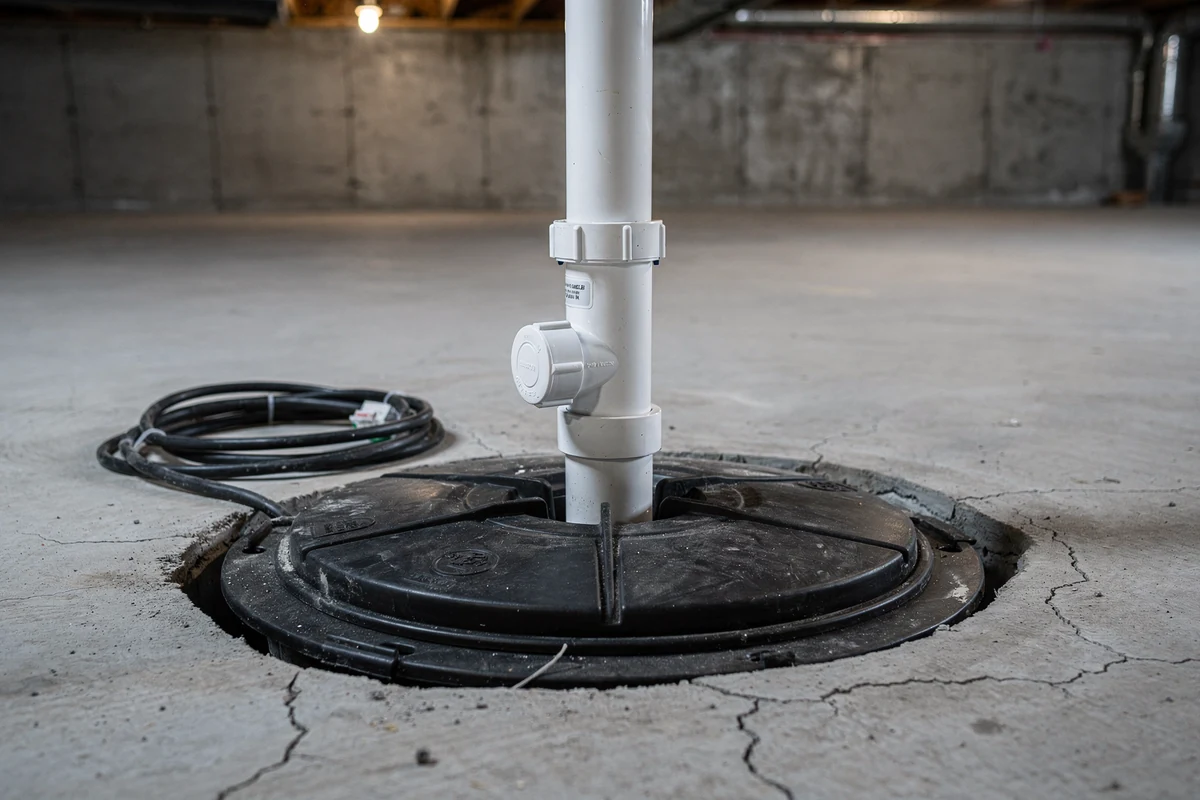
What it does not cover is the rest of a drainage system. The township issues plumbing permits itself, and a new sump pit, a new discharge line and a new electrical circuit are not landscaping under anybody's reading. The practical approach is to split the job when you describe it to the department: surface work here, plumbing and electrical there, and ask which parts they want to see.
Ground conditions and the depth rule
The township occupies the same lake plain as the city, and the soil pattern is the valley pattern: poorly to somewhat poorly drained loams and clays, seasonal water tables within a foot or two of the surface for much of the colder half of the year.
The statewide depth rule matters more here than people expect, because the township's housing stock spans a wide range of eras and construction types. Michigan requires all exterior footings and foundation systems to extend 42 inches below actual grade. That is one number for the entire state, with no county frost map, though the building official may modify the depth on evidence of freezing degree days, soil type, groundwater conditions, snow depth experience, exposure or other conditions they identify.
That last clause is a genuine local lever. Groundwater conditions are explicitly a ground on which a building official may vary footing depth, and in a township sitting on a seasonal high water table that is not a hypothetical consideration.
Where the township sits in a decision
For most township addresses the diagnosis follows the valley pattern, meaning water arriving under the slab, and interior drainage with a pump is the usual answer. Where the township differs from the city in practice is that the permit picture is clearer, the surface work exemption is explicit, and there is a floodplain information desk of its own to ask.
If the property backs onto a county drain, note that earth moving can bring the county's soil erosion permit into play on top of anything the township wants, which is covered on the exterior excavation page.
Questions people ask
- What would a permit cost on a drainage job here?
- Run the published formula. The base is 80 dollars and the remainder is calculated at 8 dollars for every 1,000 dollars of construction cost, a figure the township gives as of January 2022. On an 8,000 dollar interior system that arithmetic gives 80 plus 64, so around 144 dollars. Confirm it with the department rather than relying on a worked example on a website, but it is enough to know that the permit is not a material part of the cost.
- Is landscaping really exempt?
- The township lists siding, exchange of same size doors and windows, landscaping and paving your drive as not requiring a permit. That covers regrading and surface work around the house, which is useful, but it does not extend to the plumbing and electrical parts of a drainage system, and the township issues plumbing permits itself.
- How do I find out if I am in a floodplain?
- The township maintains a floodplain information page in its Community Development section, which is the right first stop for a township address. FEMA's map service centre also searches by address nationally. It matters because flood driven basement water and groundwater are different problems with different answers.
Where these numbers come from
- Building department address, telephone, fee formula and exemptions (Saginaw Charter Township, Building Department FAQ, checked 24 September 2026)
- Floodplain information page (Saginaw Charter Township, Community Development, checked 24 September 2026)
- Flood map search by address (FEMA Map Service Center, checked 24 September 2026)
- Footing depth 42 inches, R 408.30522 (Michigan Administrative Code, checked 24 September 2026)
Last checked 24 September 2026.