Foundation crack repair
Often the cheapest real fix in this trade, and sometimes a symptom of something that injection will not touch.
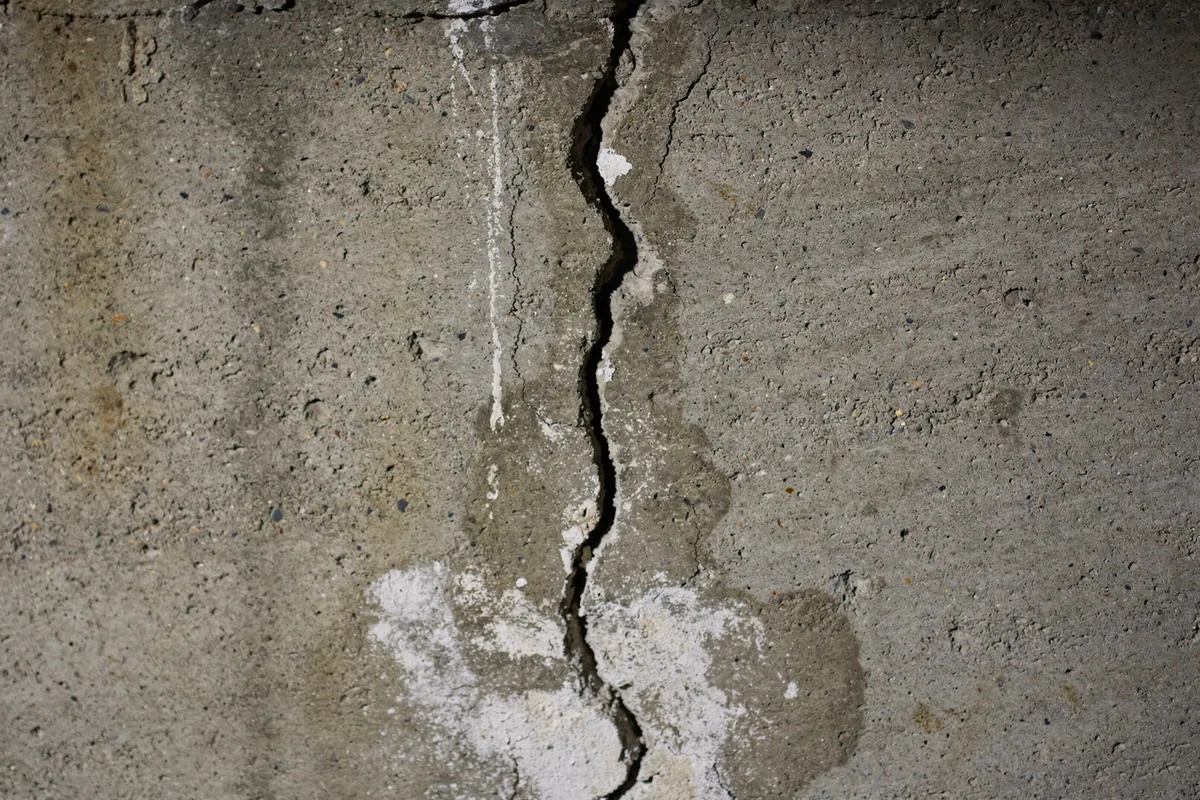
A leaking crack in a poured concrete wall is one of the few problems in this trade with a cheap, durable and well understood answer. It is also one of the easiest to over sell, because the same visit that could end in an 800 dollar injection could end in a proposal for a perimeter system, and the homeowner rarely has the information to tell which was appropriate.
What injection is
A port is set at intervals along the crack and the crack is sealed at the surface. Resin is then injected under pressure so that it travels through the full thickness of the wall rather than sitting on the face of it. Polyurethane foams as it meets water and is used where a crack is actively leaking and may still move slightly. Epoxy cures rigid and bonds the two faces back together, and is used where the concern is structural continuity in a crack that is stable and dry enough to take it.
The choice between them is a real decision and worth asking about. A rigid epoxy in a crack that is still moving seasonally will simply crack again, usually alongside the repair.
What the ground here does to walls
Clay is the reason this is a recurring local job rather than a one off. The soils across the Saginaw lowlands are heavy, and the Zilwaukee series that takes its name from the village north of the city runs 35 to 60 percent clay in the control section, is poorly drained, and carries its seasonal high water table at or just below the surface from October to June. Frankenmuth soils sit one to two feet down from November to May.
Clay of that sort swells when it takes up water and shrinks when it dries. Over a year the soil against a foundation wall is therefore pushing harder in spring than in late summer, and the wall is being cycled rather than loaded steadily. Poured walls get fine vertical cracks out of the shrinkage of the concrete itself, and the seasonal cycling then works them. That is the ordinary, unalarming version, and injection deals with it properly.
The other version is a wall that is losing the argument: a horizontal crack, a visible bow, a stair step through block joints, doors upstairs that have started to bind. Those are worth a structural opinion before anybody injects anything, and quite possibly worth an engineer rather than a contractor, because the person diagnosing the problem then has no interest in which repair is chosen.
Tie rod holes and cold joints
Two related items come up constantly in houses of a certain age here. Snap tie holes are the regularly spaced holes left where the forms were held together when the wall was poured, and they leak once the original plugs deteriorate. They are usually plugged and sealed individually and sit at the cheap end of the minor repair range.
A cold joint is the line where one pour met another that had already started to set. It shows as a roughly horizontal line, often quite straight and neat, and it can weep along its length. It is not the same as a structural horizontal crack, though it can look similar to an untrained eye, which is another reason to get a second look before agreeing to a large job.
Where crack repair fits against the bigger jobs
If your basement is wet at the floor to wall joint all the way round, or water is arriving through the slab, a crack repair is not your problem and fixing one will not change anything. That is interior drainage territory.
If the wall face is saturated over a wide area rather than weeping at a line, that points outside, and exterior work is the conversation.
If one crack is weeping and the rest of the basement is dry, then one crack is the job, and a proposal for anything substantially larger deserves a plain question about why. The cost page sets out what each of these runs so the gap between them is visible before anybody quotes.
Whichever it turns out to be, the Michigan licence is issued in named crafts and checking yours costs nothing.
Questions people ask
- Is a crack in my basement wall serious?
- Orientation tells you more than width. A vertical or near vertical crack in a poured wall, often starting at a corner of a window or at the middle of a long run, is usually shrinkage and settlement and is commonly a straightforward injection job. A horizontal crack part way up a wall, or a stair step crack following the mortar joints in a block wall, suggests the wall is being pushed by soil and water pressure from outside. That is a structural question and injecting it seals a symptom while the cause carries on.
- Why do the cracks leak only sometimes?
- Because the water table here is seasonal. The soil surveys put the high water table at or near the surface from roughly October to June across much of the valley and a foot or two down elsewhere from November to May. A crack that is dry in August and weeping in April has not changed. The water arriving at the outside of it has.
- Can I inject it myself from the hardware store?
- For a hairline crack in a dry basement that you want to tidy up, possibly. For one that leaks, the difficulty is that a surface patch applied to the inside face has water pressure behind it and tends to fail, whereas a proper injection fills the crack through the full thickness of the wall. Money spent twice is the common outcome, and the second attempt is harder because the first one is in the way.
Where these numbers come from
- Crack injection and minor repair ranges (Mansour's Innovations, Southeast Michigan trade guide 2026, checked 24 September 2026)
- Epoxy crack injection per crack (This Old House, updated March 2026, checked 24 September 2026)
- Zilwaukee series clay percentage and seasonal water table (USDA NRCS Official Series Description, checked 24 September 2026)
- Frankenmuth series water table, one to two feet November to May (USDA NRCS Official Series Description, checked 24 September 2026)
Last checked 24 September 2026.